- Business Moving Fast with AI
- ·
- Jun 01, 2026
From Human Intelligence to Trusted AI: Learning, Survival and Mastery in the AI Era - Part 2 of 5
From Learning to Survival: Why AI-Resilient Businesses Move FAST
By AgilenLite
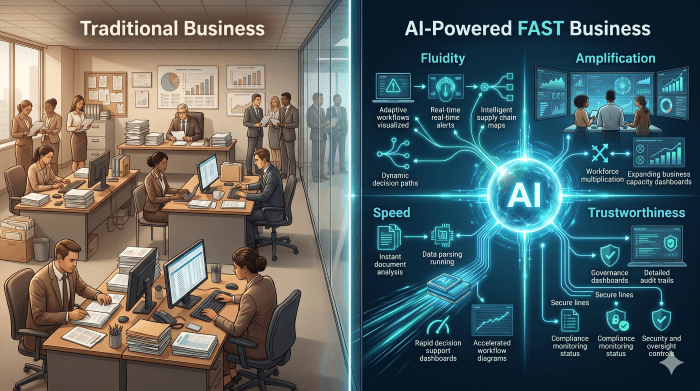
Part 2: From Learning to Survival: Why AI-Resilient Businesses Move FAST
The Gap Between Learning and Surviving
In Part 1 of this series, we drew a parallel between how babies learn and how AI learns - through observation, pattern recognition, repetition, and feedback. It was a reminder that intelligence, whether human or artificial, begins humbly. But here is the uncomfortable truth that every business leader eventually confronts:
Learning is not enough. Survival is the real test. A baby who learns to walk must eventually learn to navigate traffic. A business that experiments with AI must eventually decide whether AI is a curiosity - or a competitive necessity.
We are now firmly in the era where that decision can no longer be deferred.
Markets shift overnight. Regulations evolve without warning. Geopolitical events - an escalating trade dispute, a supply chain shock, a sudden shift in consumer expectations - can disrupt years of careful planning in a matter of days. The businesses that endure are not necessarily the largest or the most well-resourced. They are the ones structurally built to absorb disruption and keep moving.
That structural readiness has a name. We call it the FAST framework.
Introducing the FAST Framework
FAST is not a technology checklist. It is a resilience model - four pillars that describe what AI-powered organisations are capable of that their peers simply are not.
The businesses that move FAST don't just use AI. They are organised around it.
🔄 F - Fluidity (Adaptability)
Fluidity is the capacity to sense change and respond without being paralysed by it.
Consider what happened when US-Iran tensions escalated sharply in recent years. Businesses with exposure to Middle Eastern supply chains - energy, logistics, manufacturing - found themselves needing to reroute operations, renegotiate contracts, and reassess risk profiles almost overnight. For organisations relying on manual processes and slow reporting cycles, that response window was simply too narrow.
AI changes that calculus. Intelligent systems can continuously monitor signals - regulatory filings, market feeds, geopolitical developments, supplier performance data - and surface emerging risks before they become crises. Workflows can be rerouted. Scenarios can be modelled. Decisions can be made with better information, faster.
Fluidity does not mean reacting to everything. It means your organisation is no longer caught flat-footed by anything.
The question is not whether disruption will come. It is whether your structure can absorb it when it does.
📈 A - Amplification (Scale)
One of the most persistent myths in business is that scale requires headcount.
It made sense in a world of manual processes. If you needed to process more contracts, review more applications, respond to more customer queries - you hired more people. Growth was largely a function of workforce size.
AI breaks that equation.
A lean, well-governed AI deployment allows a small team to operate with the capacity of a department many times its size. Document processing that once required a team of analysts can be handled in minutes. Customer queries that required a support team across time zones can be managed continuously. Compliance reviews that required senior specialists can be augmented to run at scale without sacrificing rigour.
This is not about replacing people. It is about removing the ceiling on what a talented, focused team can achieve. Amplification means your organisational capacity is determined by your intelligence - not your invoice count.
A small team should never have to think small.
⚡ S - Speed
Speed, as we mean it here, is not about urgency. It is about the structural elimination of delay.
Take a practical example from the financial services sector. When a regulatory body issues a major update - say, a 200-page amendment to an existing compliance framework - the traditional response involves a sequential human process. An analyst reads the document, parses the relevant sections, cross-references changes against existing policies, drafts a summary memo, and circulates it for review. Done carefully, this takes days.
With AI, that same process runs in parallel. The document is ingested, cross-referenced against existing policies, and key changes are flagged - simultaneously, not sequentially. A structured summary is ready in minutes, not days. The analyst's role shifts from extraction to judgement.
Speed is not about cutting corners. It is about removing the bottleneck of linear, human-paced information processing from decisions that no longer require it.
Days become hours. Hours become minutes. The competitive edge is not velocity - it is the structural removal of delay.
🛡️ T - Trustworthiness (Consistency)
Of the four pillars, Trustworthiness is perhaps the most underappreciated - and the most consequential.
It is 4:55pm on a Friday. A senior compliance officer is reviewing a stack of contracts. They have been at it for hours. Their cognitive load is maxed. They are experienced and diligent, but they are human. The nuance absorbed carefully on page 40 may not be fully present in their working memory by the time they reach page 80. A non-standard indemnity clause - subtle, buried, consequential - slips through.
This is not negligence. It is the natural limitation of human cognition under sustained load.
AI does not experience Friday afternoon. It treats the 10,000th contract with the same precision it applied to the first. Every clause, every deviation from standard language, every anomalous term - flagged consistently, regardless of the hour, volume, or complexity.
But Trustworthiness is not just about what AI does automatically. It is about governance. When you implement AI workflows with proper oversight - defined parameters, audit trails, human review at critical decision points - you are systematically removing the risk that any individual's immediate mental state becomes a liability for the organisation.
Governed well, AI does not just produce consistent outputs. It removes a category of organisational risk that has existed as long as humans have made decisions while tired.
Why FAST Matters Now
The FAST framework is not a future ambition. It describes what leading organisations are already building - and the gap is growing between those who are and those who are not.
The businesses that will define their sectors over the next decade are not waiting to see how AI matures. They are making structural choices now: about how their teams operate, how their workflows are designed, how their decisions are governed.
They are building organisations that are Fluid enough to absorb disruption, Amplified enough to scale without constraint, fast enough to remove delay from critical processes, and Trustworthy enough to earn confidence from clients, regulators, and their own boards.
They are, in short, building to move FAST.
What Comes Next
In Part 3, we will move beyond the framework and into the practicalities of implementation - specifically, how organisations can begin building AI workflows that are not only effective, but auditable, explainable, and safe.
Because surviving with AI is one thing. Earning trust in how you do it is another.
About AgilenLite
At AgilenLite, we help organisations move from AI awareness to trusted AI adoption - with a focus on governance, security, and sustainable implementation.
Secured Today, Agile Tomorrow. Ready to explore how the FAST framework applies to your organisation?
Interested in learning more or discussing how these insights apply to your organisation? Contact us at enquiry@agilenlite.com.
Trusted AI Adoption Series:
Part 1: From Baby Learning to Machine Learning - Why AI Matters Now
Part 2: From Learning to Survival: Why AI-Resilient Businesses Move FAST
Part 3: Survival Is Not Enough: Why Trusted AI Demands Governance
Part 4: From AI Usage to Trusted AI: Why Staying SAFE Is Not Optional
Part 5: From AI Adoption to AI Mastery: How Organisations ARISE
Your Trusted Partner in Professional Growth and Innovation or Bridging the Gap Between Today’s Capabilities and Tomorrow’s Success
AgilenLite helps financial and technology teams bridge the gap between current capabilities and future success with practical, measurable solutions.
Join 3,000+ professionals who've transformed their skills through our IBF-accredited programmes
Professionals Trained
Through Career Conversion Programmes in IT Security & Cybersecurity
Corporate Professionals
Trained in cybersecurity, fraud risk, AML, and cloud security
Years of Excellence
Delivering cutting-edge training and consulting solutions