- Business's Trust Grounded with Governance
- ·
- Jun 05, 2026
From Human Intelligence to Trusted AI: Learning, Survival and Mastery in the AI Era - Part 3 of 5
Survival Is Not Enough: Why Trusted AI Demands Governance
By AgilenLite
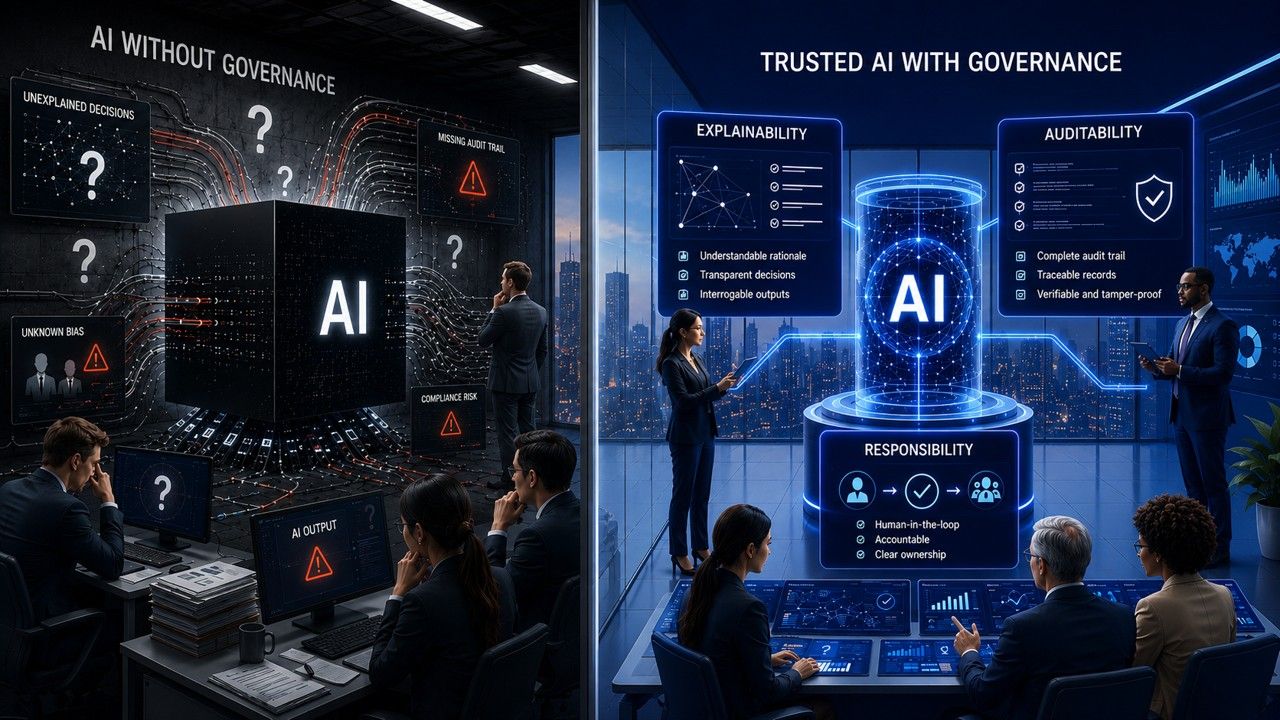
Part 3: Survival Is Not Enough: Why Trusted AI Demands Governance
The Question Nobody Asks Loudly Enough
In Part 2, we introduced the FAST framework - Fluidity, Amplification, Speed, and Trustworthiness - as the four pillars of AI resilience. We made the case that survival in today's environment demands organisations that are structurally built to move fast.
But speed without oversight is not resilience. It is risk at scale. Here is the question that separates organisations that deploy AI from organisations that can stand behind it:
How do you know your AI is doing what you think it's doing? This is not a technical question. It is a governance question. And it is the question at the heart of Part 3.
When AI Goes Wrong, It Goes Wrong Quietly
Unlike a human error - which is often visible, traceable, and correctable in the moment - AI errors can compound silently.
A model trained on historical data may encode historical biases. A document review system may systematically miss a certain class of clause not well-represented in its training set. A customer-facing AI may respond in ways that are technically accurate but contextually inappropriate - without anyone noticing until the pattern has repeated hundreds of times.
This is not a reason to avoid AI. It is a reason to govern it.
The organisations that deploy AI at scale without building governance frameworks alongside them are not moving fast. They are accumulating invisible debt - in compliance exposure, reputational risk, and eroding stakeholder trust.
Governance is not a constraint on AI adoption. It is what makes AI adoption sustainable.
Introducing the EAR Framework
Closing the governance gap requires three non-negotiables. We call it the EAR framework - because before AI acts, it needs to listen.
EAR stands for Explainability, Auditability, and Responsibility. Together, these three pillars define what it means for AI to be not just powerful, but trustworthy.
You move FAST - but you lead with your EAR.
👂 E - Explainability
Governance starts with being able to answer one simple question: why did the AI decide that?
If an AI-assisted underwriting system declines a loan application, can you explain the basis to a regulator - in terms they will accept and a client can understand? If a document review flags a clause as non-standard, is there a clear, verifiable basis for that flag that a human reviewer can interrogate?
Explainability does not mean every AI decision requires a detailed technical justification. It means the system is designed so that outputs can always be interrogated - and that the organisation is never in the position of having to say 'we don't know why it did that.'
In regulated industries - financial services, healthcare, legal, government - explainability is not a best practice. It is a baseline expectation. And increasingly, it is a legal requirement.
If you cannot explain it to your regulator, you do not fully own it.
📋 A - Auditability
Every AI-assisted decision should leave a trail.
What data did the system use? What did it flag, and what did it pass? What human reviewed the output, when, and what did they decide? If a decision is later questioned - by a client, an auditor, a regulator, or a court - can you reconstruct the logic and the process that produced it?
Auditability is particularly critical in organisations where AI is being used to augment compliance, legal, or risk functions. The standard of proof required in these contexts is high. The expectation of documentation is non-negotiable.
Building auditability into AI workflows from the outset is significantly less costly than retrofitting it after a governance failure. It also signals something important to regulators and clients: that you have thought carefully about accountability, not just capability.
An AI system without an audit trail is a liability dressed as an asset.
🧑⚖️ R - Responsibility (Human-in-the-loop)
Perhaps the most nuanced governance decision in AI adoption is this: where does the human stay?
The answer is not everywhere - that defeats the purpose of AI. But it is certainly not nowhere. The organisations that get this right are the ones that make deliberate, documented decisions about which categories of decision require human review, and why.
A useful heuristic: the higher the consequence of an error, and the more difficult that error is to detect and reverse, the stronger the case for human oversight at that step.
A customer query about an account balance? AI can handle it. A decision to flag a transaction as potentially fraudulent with consequences for a client's account? A human should be in that loop. A compliance recommendation on a regulatory matter that could expose the organisation to legal liability? Human oversight is not optional — it is a fiduciary responsibility.
Responsibility means making deliberate, documented decisions about where human judgement is irreplaceable — and honouring them consistently.
AI should accelerate human judgement. Not replace it where it matters most.
Governance Is Not the Brake - It Is the Chassis
There is a persistent misunderstanding in conversations about AI governance: that it is in tension with speed and innovation. That rigour slows things down. That oversight is a constraint on progress.
This misunderstands what governance does.
Governance is not the brake on AI adoption. It is the chassis that allows the engine to run at full speed without flying apart.
An organisation that deploys AI without governance frameworks cannot move fast sustainably. It moves fast until something breaks - and then it stops, often publicly, often expensively.
An organisation that builds governance alongside its AI deployment can move faster over time - because its stakeholders trust its outputs, its regulators recognise its diligence, and its teams have confidence in the systems they are working with.
This is what Trusted AI looks like. Not AI that is slow and cautious. AI that is fast and accountable.
Building Your Governance Foundation: Start Here
For organisations beginning this journey, the governance conversation does not need to start with complexity. It starts with three questions:
- For each AI-assisted workflow in your organisation, can you explain the basis for its outputs?
- If a decision made with AI assistance were questioned tomorrow, could you reconstruct the process that produced it?
- Have you made deliberate, documented decisions about where human review is required - and why?
If the answer to any of these is uncertain, that is where to start.
Interested in learning more or discussing how these insights apply to your organisation? Contact us at enquiry@agilenlite.com .
Trusted AI Adoption Series:
Part 1: From Baby Learning to Machine Learning - Why AI Matters Now
Part 2: From Learning to Survival: Why AI-Resilient Businesses Move FAST
Part 3: Survival Is Not Enough: Why Trusted AI Demands Governance
Part 4: From AI Usage to Trusted AI: Why Staying SAFE Is Not Optional
Part 5: From AI Adoption to AI Mastery: How Organisations ARISE
Your Trusted Partner in Professional Growth and Innovation or Bridging the Gap Between Today’s Capabilities and Tomorrow’s Success
AgilenLite helps financial and technology teams bridge the gap between current capabilities and future success with practical, measurable solutions.
Join 3,000+ professionals who've transformed their skills through our IBF-accredited programmes
Professionals Trained
Through Career Conversion Programmes in IT Security & Cybersecurity
Corporate Professionals
Trained in cybersecurity, fraud risk, AML, and cloud security
Years of Excellence
Delivering cutting-edge training and consulting solutions