- Every Change is AI-Native Focus
- ·
- Jun 11, 2026
From Human Intelligence to Trusted AI: Learning, Survival and Mastery in the AI Era - Part 4 of 5
From AI Usage to Trusted AI: Why Staying SAFE Is Not Optional
By AgilenLite
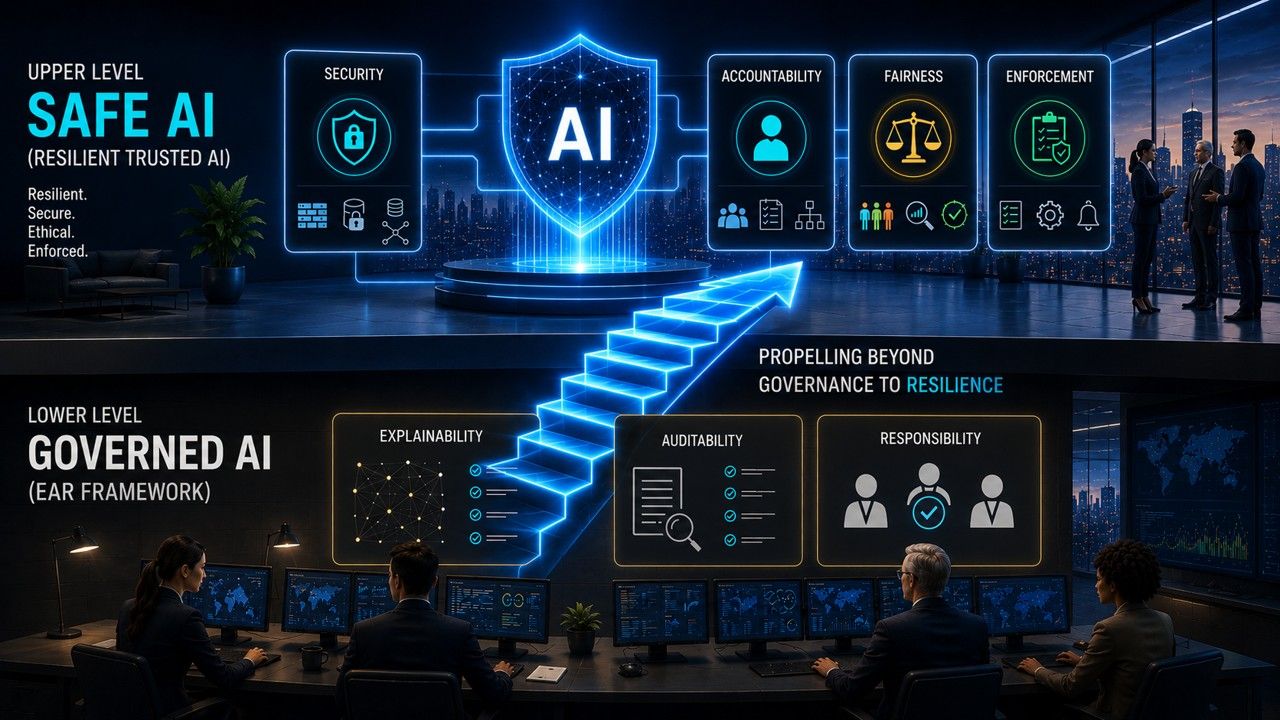
Part 4: From AI Usage to Trusted AI: Why Staying SAFE Is Not Optional
The Gap Nobody Talks About
In Part 3, we introduced the EAR framework - Explainability, Auditability, and Responsibility - the three pillars that define what it means for AI to be governed well. We made the case that Trusted AI is not just powerful. It is accountable.
But accountability and resilience are not the same thing.
There are organisations that have built governance frameworks, documented their AI policies, and still found themselves on the front page of the news for the wrong reasons. Not because they were negligent. Because they were incomplete.
Resilience is about what happens when things go wrong - and in AI adoption, something always eventually does. A data breach. A biased model output that becomes public. A compliance failure that triggers regulatory action. A security vulnerability exploited before anyone noticed it existed.
The organisations that survive these moments - and continue to operate with their reputation intact - are the ones that embedded four disciplines into the foundation of their AI deployment from the start.
We call it the SAFE framework. Because Trusted AI isn't just smart. It's SAFE.
Introducing the SAFE Framework
SAFE stands for Security, Accountability, Fairness, and Enforcement. Together, these four pillars define the resilience layer of Trusted AI adoption - the difference between an organisation that deploys AI and one that can stand behind it under pressure.
You move FAST. You lead with your EAR. You keep it SAFE.
🔒 S - Security
AI introduces a threat surface that most organisations are not yet equipped to fully understand - let alone defend.
The threats are real and they are growing. Data poisoning attacks manipulate the training data that AI models learn from, corrupting outputs at the source. Model inversion attacks allow adversaries to reverse-engineer sensitive information from AI outputs. Prompt injection - exploiting the way language models process instructions - can cause AI systems to behave in ways their developers never intended. Supply chain vulnerabilities in third-party AI components introduce risks that organisations inherit without choosing.
The 2023 MOVEit data breach, which exposed the personal data of tens of millions of individuals across hundreds of organisations, illustrated how a single vulnerability in a widely-used system can cascade into a global crisis. As AI becomes a similarly embedded layer of enterprise infrastructure, the stakes of an undefended vulnerability rise accordingly.
Security in AI adoption means knowing where your exposure lies - in your data pipelines, your model supply chain, your deployment environment, and your integration points - and building active, layered safeguards rather than relying on policy documents that assume the threat never arrives.
An AI system that can be manipulated, poisoned, or exploited is not an asset. It is a liability with an accelerator.
🧭 A - Accountability (Governance)
Governance is only real when someone owns it.
This is the gap that most organisations discover too late. They build governance frameworks. They document policies. They conduct training. And then something goes wrong - and the first question from the board, the regulator, or the media is: who was responsible for this?
If the answer is unclear, the organisation has a governance framework without accountability. And a framework without accountability is, in practice, no framework at all.
Accountability means your organisation has clearly defined who is responsible for AI decisions at every level - who owns the model, who reviews its outputs, who approves its deployment, and who answers when it fails. It means those roles are documented, communicated, and enforced - not assumed.
The 2022 collapse of several algorithmic trading operations demonstrated what happens when AI-driven decisions are made at speed without clear human accountability. When the models behaved unexpectedly, no one had clear authority to intervene decisively. The losses were not just financial. They were reputational and regulatory.
Accountability is the human infrastructure behind the technology. Without it, governance is a document, not a discipline.
⚖️ F - Fairness (AI Ethics)
AI ethics is not an abstract philosophical concern. It is a practical operational risk.
A model trained on historical data inherits historical bias. If your historical hiring decisions disadvantaged certain demographic groups, an AI model trained on that hiring data will replicate and potentially amplify that disadvantage - automatically, at scale, and with the apparent authority of algorithmic objectivity.
This is not a hypothetical. In 2018, Amazon scrapped an AI recruiting tool after discovering it systematically downgraded CVs from women, having been trained on a decade of historically male-dominated hiring data. The model was doing exactly what it was trained to do. The problem was what it had been trained on.
Fairness means actively testing AI systems for discriminatory outputs before deployment and continuously monitoring for bias drift after deployment. It means being transparent with the people affected by AI decisions about how those decisions are being made. And it means having a clear process for identifying, reporting, and correcting unfair outputs when they occur.
In an environment of increasing regulatory scrutiny - the EU AI Act, the UK's AI Safety frameworks, Singapore's Model AI Governance Framework - fairness is no longer a voluntary commitment. It is becoming a compliance requirement.
An AI system that is fast, scalable, and consistently unfair is not a competitive advantage. It is a regulatory and reputational crisis waiting to happen.
📋 E - Enforcement (Compliance)
Compliance is only as strong as its enforcement.
This is the hardest lesson for organisations that have invested in building governance frameworks. The framework exists. The policies are documented. The training has been delivered. And yet, in practice, the AI system is being used in ways that deviate from the approved parameters - because enforcement mechanisms are absent, inconsistent, or unenforced.
Enforcement means your AI governance framework is embedded in daily operations - not filed in a policy repository. It means audit trails are generated automatically, not reconstructed after the fact. It means deviations from approved usage trigger alerts, not just future regret. It means there are documented consequences for non-compliance, and those consequences are applied consistently.
The financial services sector has learned this lesson repeatedly. The 2012 Knight Capital Group trading loss - $440 million in 45 minutes - resulted from a software deployment that activated an untested algorithm. The governance failure was not the absence of policies. It was the absence of enforcement mechanisms that would have caught the deviation before it compounded.
Policies without enforcement are aspirations. Enforcement is what turns a governance framework into a governance practice.
What Happens When Organisations Are Not SAFE
The business graveyard of AI failures is well-populated. The common thread is rarely ignorance. It is the belief that governance frameworks are sufficient without the resilience disciplines that make them real.
Samsung's 2023 employee data leak occurred when engineers uploaded proprietary source code and internal meeting notes to ChatGPT. The organisation had AI policies. What it lacked was enforcement - technical controls that would have prevented sensitive data from being processed by external AI systems.
Air Canada's chatbot hallucination case - in which an AI system provided a passenger with incorrect refund policy information that a court subsequently held the airline responsible for - was a failure of accountability. No one had clearly defined who was responsible for the accuracy of AI-generated customer communications, or what the escalation process was when those communications were wrong.
These are not edge cases. They are early examples of a pattern that will repeat with increasing frequency as AI becomes more deeply embedded in enterprise operations.
The cost of not being SAFE is not a future risk. It is a present reality for organisations that treat resilience as optional.
The Complete Picture: FAST, EAR, SAFE
Across this series, we have built a framework for Trusted AI adoption that operates at three levels:
- FAST - Fluidity, Amplification, Speed, Trustworthiness: the resilience model for AI-powered organisations.
- EAR - Explainability, Auditability, Responsibility: the governance framework for accountable AI.
- SAFE - Security, Accountability, Fairness, Enforcement: the resilience disciplines that protect everything you have built.
Move FAST. Lead with your EAR. Keep it SAFE.
This is not a checklist. It is a culture. The organisations that will define their sectors over the next decade are not the ones that deployed AI the fastest. They are the ones that built it right.
What Comes Next
In Part 5 - the final instalment of this series - we bring everything together. From learning to survival, from governance to resilience: what does mastery of Trusted AI adoption actually look like, and how do you build an organisation that doesn't just adopt AI, but leads with it?
The journey from AI usage to Trusted AI ends not with a framework. It ends with a culture.
About AgilenLite
At AgilenLite, we help organisations move from AI awareness to trusted AI adoption - with a focus on governance, security, and sustainable implementation.
Secured Today, Agile Tomorrow.
Ready to build AI that is not just powerful - but SAFE? Contact us at enquiry@agilenlite.com
Trusted AI Adoption Series:
Part 1: From Baby Learning to Machine Learning - Why AI Matters Now
Part 2: From Learning to Survival: Why AI-Resilient Businesses Move FAST
Part 3: Survival Is Not Enough: Why Trusted AI Demands Governance
Part 4: From AI Usage to Trusted AI: Why Staying SAFE Is Not Optional
Part 5: From AI Adoption to AI Mastery: How Organisations ARISE
Your Trusted Partner in Professional Growth and Innovation or Bridging the Gap Between Today’s Capabilities and Tomorrow’s Success
AgilenLite helps financial and technology teams bridge the gap between current capabilities and future success with practical, measurable solutions.
Join 3,000+ professionals who've transformed their skills through our IBF-accredited programmes
Professionals Trained
Through Career Conversion Programmes in IT Security & Cybersecurity
Corporate Professionals
Trained in cybersecurity, fraud risk, AML, and cloud security
Years of Excellence
Delivering cutting-edge training and consulting solutions