- Be the AI-Native Champion Inside Out
- ·
- Jun 17, 2026
From Human Intelligence to Trusted AI: Learning, Survival and Mastery in the AI Era - Part 5 of 5
From AI Adoption to AI Mastery: How Organisations ARISE
By AgilenLite
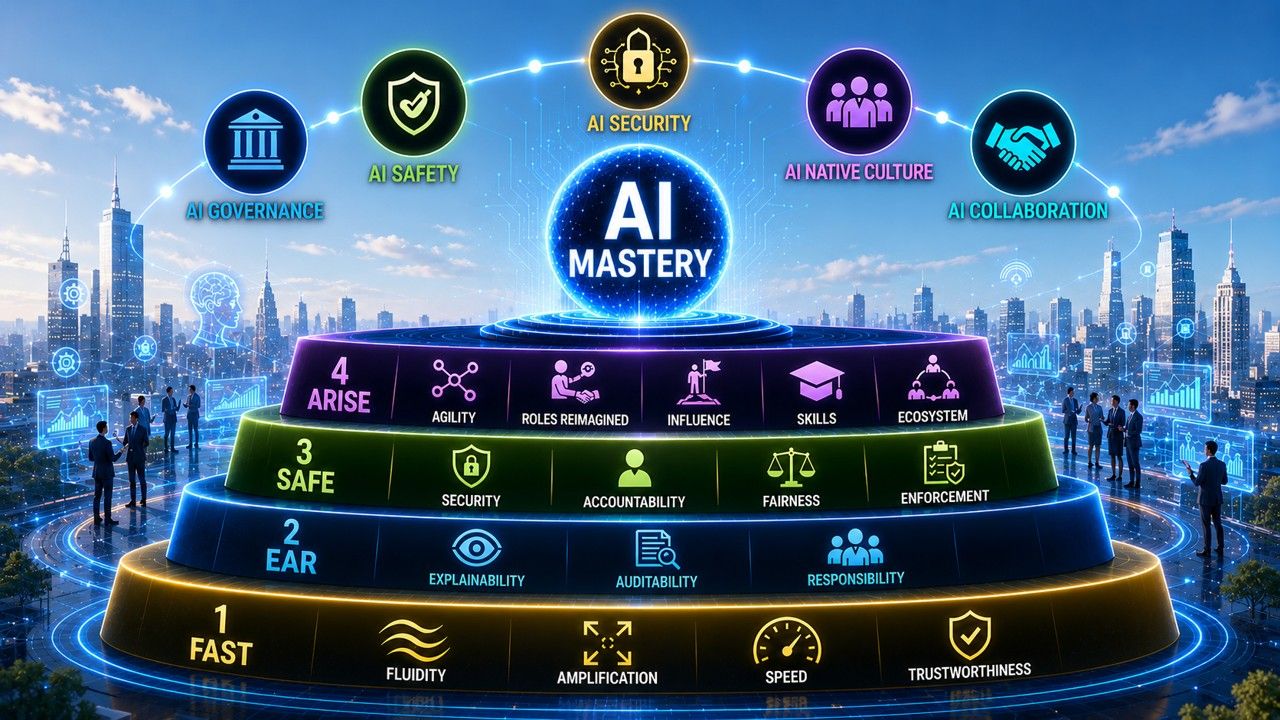
We Started With a Baby. We End With a Leader.
In Part 1 of this series, we drew a parallel between how babies learn and how organisations begin their AI journey - through observation, pattern recognition, and incremental confidence. It was a humble starting point, deliberately so. Because the most important thing about AI adoption is not where you begin. It is how far you are willing to go.
Over four parts, we built the complete framework for Trusted AI adoption:
Part 1 - Learning : How AI learns, and why that shapes how we must adopt it. Part 2 - Survival is Not Enough (FAST): Fluidity, Amplification, Speed, Trustworthiness - the resilience model for AI-powered organisations. Part 3 - Governance (EAR): Explainability, Auditability, Responsibility - the pillars of accountable AI. Part 4 - Resilience (SAFE): Security, Accountability, Fairness, Enforcement - the disciplines that protect everything you build.
But frameworks are not the destination. They are the foundation.
Part 5 is about what the best organisations build on top of that foundation. It is about the shift from AI adoption to AI mastery - from using AI as a tool to becoming an organisation where AI is woven into the culture, the strategy, and the DNA.
This is the journey from AI-enabled to AI-native. And it begins not with a technology decision - but with a cultural one.
What Does It Mean to Be AI-Native?
There is a meaningful and consequential difference between an organisation that uses AI and one that is AI-native.
An organisation that uses AI has deployed tools. It has automated some workflows, improved some processes, and reduced some costs. It treats AI as a capability - valuable, but bolt-on. When a new AI tool emerges, it evaluates whether to add it. When a process needs improving, it asks whether AI could help.
An AI-native organisation thinks entirely differently. It does not ask whether AI fits into its strategy. AI is its strategy. It does not train employees to use AI tools. It builds a culture where thinking with AI is as natural and expected as thinking with data. It does not bolt governance on as an afterthought. It makes FAST, EAR, and SAFE the invisible architecture of everything it does.
The shift is not primarily technological. It is cultural. And culture change - sustained, organisation-wide, values-driven culture change - requires leadership, structure, and intentionality.
AI-native organisations don't adopt AI. They become it.
Introducing the ARISE Framework
The transformation from AI adoption to AI mastery is built on five pillars. We call it the ARISE framework - because the organisations that complete this journey don't just grow. They rise into a fundamentally different category of enterprise.
Move FAST. Lead with your EAR. Keep it SAFE. Watch your organisation ARISE.
🔄 A - Agility (Workflow Redesign)
The first and most visible marker of an AI-native organisation is how its work gets done.
Most early AI adopters retrofit - they take existing workflows and layer AI capabilities on top. The report is still written the same way; it just uses AI to draft a section. The customer query is still handled the same way; it just has an AI chatbot as the first touchpoint. The process is faster. But it is not fundamentally different.
AI-native organisations do something more radical. They start from a blank page and ask: if we were designing this workflow today - knowing what AI can do - how would we build it? The answer is almost always structurally different from what exists.
Processes are rebuilt around AI agents from the ground up. Roles are redefined not around tasks, but around the judgement calls that only humans can make. Handoffs between human and machine are designed deliberately, not assumed. The result is not a faster version of the old way of working. It is a new way of working that is dramatically more effective.
Amazon's fulfilment operations, which use AI to redesign the physical and logical flow of warehouse work around machine capabilities rather than human limitations, offer a glimpse of what this looks like at scale. The workflow was not grown around AI. It was designed with AI as a native participant.
Agility is not adding AI to old processes. It is redesigning processes knowing AI exists.
👥 R - Roles Reimagined (Human Judgement)
The most persistent fear in AI adoption - that AI will replace human workers - misunderstands the nature of what AI does well and what humans do irreplaceably.
AI excels at processing information at scale, identifying patterns in large datasets, generating options and drafts, and executing defined tasks with consistency. It does not excel at navigating ambiguity, exercising contextual judgement, taking ethical responsibility, or making decisions whose consequences extend beyond the immediate transaction.
AI-native organisations have resolved this tension not by choosing between humans and machines, but by designing clearly around the boundary. They identify - deliberately, specifically - which decisions require human ownership. Strategy. Ethics. Final accountability. Relationships. And they build AI into everything that feeds those decisions, so that human judgement is exercised with better information, faster, and with less cognitive burden.
The question that defines a Roles Reimagined organisation is not 'what does AI replace?' It is 'what does AI amplify?' - and how do we redesign roles so that humans spend their time on the things only humans can do?
Satya Nadella's transformation of Microsoft - repositioning every product and role around AI as a copilot rather than a replacement - is the most visible enterprise-scale example of this reframing. The cultural shift preceded and enabled the technological one.
Humans don't compete with AI. They own what AI cannot - strategy, ethics, and the decisions that matter most.
🌟 I - Influence (The AI-Native Culture Champion)
Culture does not change by decree. It changes through influence - and specifically through the sustained, visible, credible influence of leaders who model the new way of working and make it safe for others to follow.
Every AI-native organisation has, at its core, what we call an AI-Native Culture Champion. This is not necessarily a title. It is a function - the function of driving the transition from using AI tools to building an organisation fundamentally structured around human-machine collaboration.
The AI-Native Culture Champion has four core responsibilities. Mindset Shifting: transitioning employees from 'AI replaces me' to 'AI amplifies me' - through visible leadership, honest communication, and genuine psychological safety to experiment without fear. Skill Democratisation: ensuring that non-technical staff can confidently use low-code and no-code AI tools, removing the barrier between 'AI people' and everyone else. Workflow Redesign: leading the systematic overhaul of processes to embed AI touchpoints directly into daily tasks, not as additions but as foundations. Ethical Guardrails: establishing and maintaining the standards for responsible AI use - data governance, bias mitigation, transparency - as living practices rather than static policies.
The Champion is not always the most senior person in the room. But they are always the most committed to making the culture real, rather than aspirational.
AI-native culture does not emerge. It is championed - by leaders willing to model what they are asking others to become.
🎓 S - Skills (AI Fluency and Continuous Upskilling)
An AI-native organisation is one where every employee - not just the technical teams - has reached a baseline level of AI fluency.
AI fluency does not mean everyone can build a model. It means everyone can think with AI: identify where AI might improve their work, prompt and iterate effectively, evaluate AI outputs critically, and recognise the limits of what AI should and should not be trusted to do.
Building this fluency across an organisation requires three things working together. Psychological safety: staff must feel safe experimenting without fear that errors will be penalised or that demonstrating AI capability will accelerate their redundancy. Continuous upskilling: as AI models evolve rapidly, learning cannot be a one-time event - micro-learning, embedded in the flow of work and targeted to specific roles, is more sustainable than periodic training programmes. Incentivised innovation: organisations that visibly reward teams for successfully automating or enhancing their own workflows signal clearly that AI fluency is valued and celebrated, not merely expected.
IBM's SkillsBuild programme - committed to retraining hundreds of thousands of employees and external learners in AI-relevant skills - reflects the scale of investment that building genuine AI fluency requires. The organisations that build this capability now will have a structural advantage that compounds over time.
AI fluency is not a technical skill. It is an organisational capability - and building it at scale is a leadership responsibility, not an IT one.
🌐 E - Ecosystem (AI-Native Culture)
The final pillar of ARISE is the most expansive - and the most defining.
An AI-native ecosystem is one where AI safety, governance, security, and citizenship are not policies to be checked against before launch. They are defaults - the baseline expectation in every product built, every service delivered, every workflow designed, every vendor engaged, every partnership formed.
This is what distinguishes an AI-native organisation from one that has simply deployed AI at scale. In an AI-native ecosystem, the questions that govern AI use are not asked by the compliance team during an annual review. They are asked by every team, at every stage, as a natural part of how work gets done. 'How is AI being used here, and is it being used responsibly?' is not an audit question. It is a design question.
The ecosystem extends beyond the organisation's walls. AI-native organisations think carefully about how their AI use affects their customers, partners, communities, and industry. They recognise that AI citizenship - the responsible use of AI in ways that contribute positively to the broader environment - is not separate from their business strategy. It is part of it.
Organisations like Microsoft, Google DeepMind, and GovTech Singapore have published detailed AI governance frameworks not just for internal compliance, but as a signal to their ecosystems: this is how we use AI, this is what we stand for, and this is the standard we hold ourselves and our partners to.
An AI-native ecosystem is one where responsible AI is not the exception. It is the expectation - built into the culture before it is built into the code.
What It Takes to Begin: The ARISE Journey
Becoming AI-native is not a project with a completion date. It is a journey with a clear direction. For organisations ready to take the first step, the path looks like this:
1. Assess AI Readiness: Understand honestly where your organisation sits across FAST, EAR, and SAFE. What is working? Where are the gaps? What is the cost of inaction? 2. Identify Champion Leaders: Find the individuals - at every level - who embody the AI-native mindset and are willing to model it publicly. The Champion need not be the CEO. But they must be credible, committed, and empowered to act. 3. Run Co-Pilot Experiments: Start with contained, low-risk experiments where AI and humans work side by side. Build confidence, surface the learning, and use the results to make the case for broader adoption. 4. Embed AI into Enterprise Strategy: AI-native strategy is not a technology strategy. It is a business strategy. 'How does AI fit into what we are building?' becomes a standard agenda item at every strategic planning session - not a footnote. 5. Cultivate the Ecosystem: Extend the culture outward - to partners, suppliers, clients, and communities. An AI-native organisation does not operate in isolation. It leads and shapes its ecosystem.
The journey from AI usage to AI mastery does not begin with a technology decision. It begins with a cultural one.
The Complete Framework: A Journey in Four Acronyms
Across this five-part series, we have built a complete, interconnected framework for Trusted AI adoption. Each layer reinforces the others. None stands alone.
Move FAST. Lead with your EAR. Keep it SAFE. Watch your organisation ARISE.
FAST gives you the structural resilience to compete. EAR gives you the governance to be trusted. SAFE gives you the disciplines to endure. And ARISE gives you the culture to lead.
The organisations that will define their sectors over the next decade are not the ones that deployed AI the fastest. They are the ones that built it right - with intention, with governance, with resilience, and with a culture that treats AI not as a tool, but as a collaborator.
That is what Trusted AI looks like at mastery. Not just intelligent. Not just fast. Not just safe. Transformative.
Your Next Step Starts Here
The question is no longer whether your organisation should adopt AI. That decision has been made - by your competitors, your regulators, your customers, and the market.
The question is whether you will adopt it in a way that builds lasting advantage - or in a way that creates invisible risk.
At AgilenLite, we work with organisations at every stage of this journey - from initial AI readiness assessments to the design of AI-native operating models and governance frameworks. Whether you are taking your first steps with FAST, closing governance gaps with EAR, building resilience disciplines with SAFE, or beginning the cultural transformation of ARISE - we are here to help you do it right.
Three ways to take the next step:
→ Read the full series: www.agilenlite.com/blogs → Start a conversation: enquiry@agilenlite.com → Follow AgilenLite on LinkedIn for ongoing insights and the next series on Trusted AI adoption.
The journey from AI usage to Trusted AI mastery is not a straight line. But it has a clear direction.
Let's build it together.
About AgilenLite
AgilenLite is a trusted advisor to organisations navigating the transition from AI awareness to Trusted AI adoption. Our work spans AI governance design, security frameworks, readiness assessments, and the cultural transformation required to become AI-native.
Secured Today, Agile Tomorrow.
Interested in learning more or discussing how these insights apply to your organisation? Contact us at enquiry@agilenlite.com
Trusted AI Adoption Series:
Part 1: From Baby Learning to Machine Learning - Why AI Matters Now
Part 2: From Learning to Survival: Why AI-Resilient Businesses Move FAST
Part 3: Survival Is Not Enough: Why Trusted AI Demands Governance
Part 4: From AI Usage to Trusted AI: Why Staying SAFE Is Not Optional
Part 5: From AI Adoption to AI Mastery: How Organisations ARISE
Your Trusted Partner in Professional Growth and Innovation or Bridging the Gap Between Today’s Capabilities and Tomorrow’s Success
AgilenLite helps financial and technology teams bridge the gap between current capabilities and future success with practical, measurable solutions.
Join 3,000+ professionals who've transformed their skills through our IBF-accredited programmes
Professionals Trained
Through Career Conversion Programmes in IT Security & Cybersecurity
Corporate Professionals
Trained in cybersecurity, fraud risk, AML, and cloud security
Years of Excellence
Delivering cutting-edge training and consulting solutions